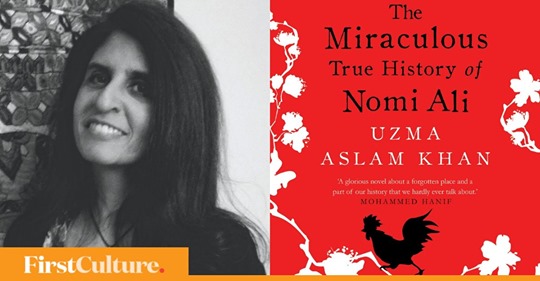
After 50 years, Pakistan's leading monthly magazine, Herald, is suspending publication. A huge, huge loss--I've always loved reading and occasionally writing for one of the few media outlets in Pakistan to consistently support art and culture, while providing bold, in-depth coverage of local and global events. Though so bittersweet, I couldn't be more honored that in this last issue, my novel The Miraculous True History of Nomi Ali has gotten an expansive, detailed, beautiful review by the writer Osama Siddique. It's a review to dream of--a three-page spread about the prose, as well as the specificity and universality, past and present, of the novel's context. An excerpt:
'In important ways, even more so than a good history book, it is good fiction that is truly capable of capturing not just what it is factually known to have transpired but also the attendant hopes, dreams, and emotions of a people and an era. Such a work of fiction miraculously lifts the mists of collective forgetfulness. The Miraculous True History of Nomi Ali performs that vital and welcome miracle ... The voices of the past have been successfully captured and amplified by this remarkable novel ... (with a) dream-like quality to (the) beautiful prose. (It) is a novel about pain, loss and systematic exploitation but ultimately, it is also about injustice that transcends time and locale. And yet ... it does not obfuscate injustice as a neutral, ahistorical and decontextualized phenomenon. It provides no leeway for the unjust to breathe easy. In Khan's politics, the ingloriousness of empires, the tyranny of the oppressors and suffering of the victims are not abstract ideas. She engages with these ideas through specific stories with a definite history and a particular geography--a history and geography that keep repeating ... At the same time, all that in no way prevents her from also successfully exploring the universality of the phenomena. Therein lies the great success of the novel.'
With so much gratitude to the magazine and the reviewer.
Review of THE MIRACULOUS TRUE HISTORY OF NOMI ALI in The Indian Express
'Khan is adept at creating worlds that are at once magical and terrifying. She creates a universe out of a footnote of history. Her writing is crystal, vivid.'
https://indianexpress.com/article/lifestyle/books/across-the-black-waters-the-miraculous-true-history-of-nomi-ali-580571/
INTERVIEW IN FRONTLINE MAGAZINE: 'The story has to come from within'
Interview with eminent writer, journalist, and Associate Editor of Frontline magazine, Ziya Us Salam
https://frontline.thehindu.com/arts-and-culture/article28064266.ece
Extract:
There are many histories and many ways of looking at history. Yet there is a common strand of marginalization of the role of women. History is often told from a male gaze. How challenging was it to address these inequities in a work of historical fiction?
At the start, it wasn't challenging so much as frustrating. I encountered references to women as either feminine ideals--dutiful and chaste sisters and wives who supported the efforts of men, mostly through social work--or else championed for being 'as strong as men.' There the narrative stopped. The social and sexual stigma around their life in the prison colony meant that they were barely if ever mentioned in books written by men.
It must have been frustrating?
At some point, I stopped caring about what had or had not been said. I entered that other world, the one of fiction, where the focus is on language and character. The unnamed political prisoner was the first character I wrote, over twenty-six years ago. My interest was, from the start, in her daily and interior life, as someone transported and imprisoned. I didn't want to erase or champion her: I wanted to know her as a person, in her entirety. She was a seed that I carried with me, across many seas. I just had to be patient. I had to let her speak. The same was true for Nomi, who in a sense becomes the keeper of her family's history. I wanted to know how she got there. I wanted to value her life, as a young girl who grows up not only between two colonial powers, but between two parents who largely don't see her. I just had to hold her, and listen, and forget about any other gaze.
The book took around 26 years to be completed. Yet it has a seamless narrative. How challenging was it to keep coming back to it after each of your other novels?
There is a lovely compliment embedded in your question. Thank you. I have actually asked myself the same question. How did I slip back into this book, after immersing myself totally, body and soul, in each of the others? And now I am not complimenting myself so much as acknowledging that I don't quite understand. I think the simple reason is love. The unnamed prisoner, Nomi, Shakuntala, Aye, Haider Ali--I simply could not abandon them. They seemed to know it because they never left me either.
Mind you, this doesn't mean I love the characters in my other books any less. It means there is never a choice--you love who you love. Through writing, I've discovered a greater capacity to hold love for multiple people across time and place.
***
Read the full interview here: https://frontline.thehindu.com/arts-and-culture/article28064266.ece
https://frontline.thehindu.com/arts-and-culture/article28064266.ece
Extract:
There are many histories and many ways of looking at history. Yet there is a common strand of marginalization of the role of women. History is often told from a male gaze. How challenging was it to address these inequities in a work of historical fiction?
At the start, it wasn't challenging so much as frustrating. I encountered references to women as either feminine ideals--dutiful and chaste sisters and wives who supported the efforts of men, mostly through social work--or else championed for being 'as strong as men.' There the narrative stopped. The social and sexual stigma around their life in the prison colony meant that they were barely if ever mentioned in books written by men.
It must have been frustrating?
At some point, I stopped caring about what had or had not been said. I entered that other world, the one of fiction, where the focus is on language and character. The unnamed political prisoner was the first character I wrote, over twenty-six years ago. My interest was, from the start, in her daily and interior life, as someone transported and imprisoned. I didn't want to erase or champion her: I wanted to know her as a person, in her entirety. She was a seed that I carried with me, across many seas. I just had to be patient. I had to let her speak. The same was true for Nomi, who in a sense becomes the keeper of her family's history. I wanted to know how she got there. I wanted to value her life, as a young girl who grows up not only between two colonial powers, but between two parents who largely don't see her. I just had to hold her, and listen, and forget about any other gaze.
The book took around 26 years to be completed. Yet it has a seamless narrative. How challenging was it to keep coming back to it after each of your other novels?
There is a lovely compliment embedded in your question. Thank you. I have actually asked myself the same question. How did I slip back into this book, after immersing myself totally, body and soul, in each of the others? And now I am not complimenting myself so much as acknowledging that I don't quite understand. I think the simple reason is love. The unnamed prisoner, Nomi, Shakuntala, Aye, Haider Ali--I simply could not abandon them. They seemed to know it because they never left me either.
Mind you, this doesn't mean I love the characters in my other books any less. It means there is never a choice--you love who you love. Through writing, I've discovered a greater capacity to hold love for multiple people across time and place.
***
Read the full interview here: https://frontline.thehindu.com/arts-and-culture/article28064266.ece
Two more loving reviews for The Miraculous True History of Nomi Ali
'Khan paints her characters with a loving, generous hand ... urging you to remember, and urging you to find delight in the remembering.' Open magazine https://www.openthemagazine.com/article/books/the-act-of-remembering
'Language remains the strongest character in the narrative ... A consummate storyteller, (Khan) keeps readers engrossed till the end. It is one story that you should not miss.' Tribune
https://www.tribuneindia.com/news/sunday-special/book-reviews/history-s-dark-chapter/775037.html
INTERVIEW IN FIRST POST: Imagining the unimaginable with historical fiction
https://www.firstpost.com/living/uzma-aslam-khan-on-the-miraculous-true-history-of-nomi-ali-imagining-unimaginable-with-historical-fiction
I speak about the book and how it began, and its resonance with today. Also included in the article are a brief excerpt and a wonderful review: "The Miraculous True History of Nomi Ali is a vibrant defiance of traditionally accepted histories ... Khan writes of the lives that history would rather ignore, creating a brilliant gash in the narrative structure historically manufactured."
Whales: Past, Present, and Endangered
Magical whale-watch, the closest I've come to a living whale. As some of you may know, I once wrote a novel, The Geometry of God, about a young girl who finds the fossil of Pakicetus, a hoofed whale that lived about 55 million years ago in what is now Pakistan. The actual fossil was discovered by an American man in the Salt Range mountains, about three hours from Lahore, where I lived at the time. I had fun fictionalizing the find, crediting a Pakistani girl for her smarts, drawing pictures of Pakicetus and other walking and amphibious prehistoric whales to include in the story. I'd always wanted to draw weird and beautiful things for a book of my own ever since reading Saint-Exupery's heartbreaking The Little Prince.
Before then, in 1995, I'd seen a humpback breach in Maui, next to an astonished kayaker who began kayaking a little frantically, as the whale kept breaching.
Next sighting was in 2008, also in Maui, on a whale-watching trip where we saw a pod of humpbacks blowing and breaching, but it was pretty far and folks were more interested in a cocktail-and-sunset Hawaii, making me mostly want to get off the boat (but for the fleeting visitors on the water).
Then, last Sunday, on April 14 2019, off Plymouth, MA, this humpback romped around our boat for half an hour, blowing us a perfect concentric kiss, floating on its back, reversing the gaze. We also saw a pod of five humpbacks; a solitary right whale (critically endangered so we did not linger; it's called the right whale as it is slow and feeds on the surface, making it the right one to kill); a solitary finback (the second largest whale after blue whales, and the fastest); a pod of minkes. Tons of white-sided Atlantic and common dolphins, harbor porpoises, and gray and harbor seals, feasting alongside.
A beautiful gift of a day, the sort that, like whales, happens only once.
Subscribe to:
Posts (Atom)
-
Thrilled to receive this full-page review of The Miraculous True History of Nomi Ali in the Swedish paper Svenska Dagbladet . Aptly, it app...
-
For once I’ve a good reason for being negligent about my blog. Pain is a mighty nuisance. It’s also thought-provoking. Last year in ...
-
Excited for this discussion with @readingpakistan, who selected The Geometry of God as the book club read for October. Meeting ID: 846 ...